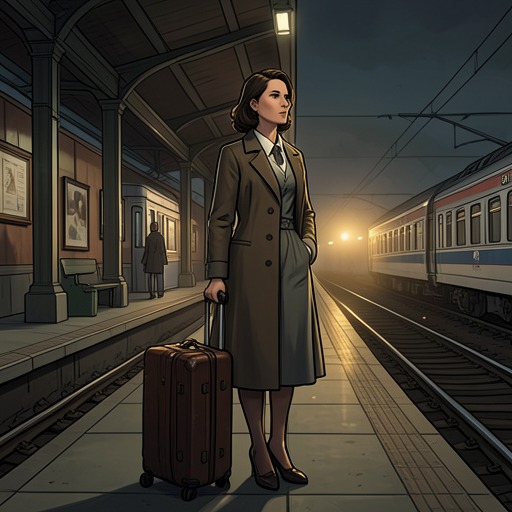
Natasha and Daniel reunite on a plane ten years later
The Sun is Also a StarNatasha Kingsley and Daniel Jae Ho Bae reunite on an airplane ten years after their separation, in a scene that brings a quiet act of gratitude and a long-delayed recognition into the same cabin. The meeting reconnects three lives: Irene, whose response to Natasha’s earlier message helped her survive a suicidal crisis, finally gets to thank the person who reached her; Natasha discovers that the young man nearby is Daniel; and the story’s long separation gives way, at last, to mutual recognition.
The lives that lead to the flight
The reunion carries the history of Natasha’s departure from the United States. Her family had left Jamaica when she was a child, and she had expected to see the relatives and friends she left behind again. Only later did she understand that undocumented status could make going home impossible and turn a familiar country into a foreign place. Years afterward, she was forced to leave the United States for Jamaica. Back in Kingston, she entered Sixth Form, studied for Caribbean Advanced Proficiency and A-level exams, and waitressed because money was scarce. She first imitated a Jamaican accent and eventually acquired it, found a circle of friends, and grew to love the country where she was born.
That adjustment did not make the separation from Daniel easy. Natasha let him go because she could not live in two worlds at once without being pulled apart. Daniel, meanwhile, declined Yale, moved out of his parents’ house, worked two jobs, and attended Hunter College part-time as an English major. He wrote small, sad poems; even those not explicitly about Natasha remained shaped by her. Across the distance, he heard her new accent as evidence that she was slipping away. The years therefore changed both their daily lives, but did not erase the relationship that the airplane encounter brings back into view.
Irene’s debt of gratitude
Before the reunion, Irene’s life had also been redirected by Natasha. While working at United States Citizenship and Immigration Services, Irene had seen Natasha every day. Natasha later left a message thanking her. That message shifted something in Irene—not enough to heal her, but enough to make her call a suicide prevention hotline. The call led to therapy, and therapy to medication that continues to save her life.
Two years after that crisis, Irene left her job at United States Citizenship and Immigration Services and became a flight attendant, a childhood ambition. She came to think of herself as a guardian angel with metallic wings. Knowing how lonely airplanes can be, and how desperate loneliness can become, she paid particular attention to passengers who might need comfort: people traveling alone to funerals, or those afraid of flying. Her care for strangers thus grows directly from the change Natasha’s message helped set in motion. On this flight, Irene is not merely serving passengers; she is given a chance to address the person to whom she has wanted to express her thanks for ten years.
Recognition in the cabin
During her final checks before takeoff, Irene notices the young man in seat 7A. He is Asian, with short black hair and kind, serious eyes, writing in a small black notebook and chewing the top of his pen between thoughts. Irene admires how unselfconscious he seems, as though he were alone in the world. A few seats away, in 8C, a young Black woman wears earbuds; her large curly Afro is dyed pink at the ends. Irene freezes when she recognizes Natasha’s face and wonders whether this can really be the girl who saved her life.
The captain’s takeoff announcement forces Irene to sit in her jumpseat, but the pause does not settle her uncertainty. Once she can speak to Natasha, Irene explains the earlier day in New York through its details: the gray bin, the Nirvana album-cover phone case, and the fact that she had seen Natasha every day. Natasha watches her warily. Pain crosses her face, suggesting that the memory belongs to a difficult history as well as to Irene’s gratitude. Irene continues anyway, telling Natasha that she saved her life. Natasha does not understand at first; her Caribbean accent carries traces of something else, registering the years and places between the two women.
Daniel and the return of the past
Irene takes Natasha’s hand. Natasha tenses but allows the contact, while other passengers look on. The scene briefly makes ordinary physical reality seem unstable: Irene imagines the plane dissolving and its passengers disappearing, leaving only herself and Natasha suspended between possible histories. That vision gives way when Natasha says she remembers Irene and gives her name. The two women’s recognition is complete, but another connection is about to surface.
The young man in 7A peers over the seat and says Natasha’s name. His face is open, his world filled with love. Natasha looks up and recognizes Daniel. She says his name twice. The plane, seats, passengers, and bodies return to solidity in Irene’s momentary vision, as if the reunion has restored the world around the two people who have found each other again. The ending confirms their recognition without narrating what follows: after years in which distance and changed lives strained their bond, Natasha and Daniel are once more face to face.
Significance of the encounter
The event joins outcomes that had seemed separate. Natasha’s message was a small expression of thanks, not a promise that she would ever see Irene again; nevertheless, it helped lead Irene away from a suicide attempt and toward a life of caring for lonely travelers. The later meeting lets Irene name that consequence directly. At the same time, the airplane places Natasha and Daniel together through coincidence rather than through a narrated plan, turning an everyday journey into the setting for a reunion the story has withheld for a decade.
The scene also makes migration and belonging present without resolving them into a simple return home. Natasha has built a life in Jamaica and changed during the years apart, while Daniel has made choices of his own in New York. Recognition does not undo those histories. Instead, the final exchange shows that change and memory coexist: Natasha remembers Irene, and she recognizes Daniel when he calls her name. The narrative ends at that moment of mutual recognition, leaving the reunion itself as the decisive change.